
RF Charging for the Modern Home: Convenience vs. Safety Myths
Author
Admin
Date
2026-06-26 13:00
Views
201
Smart Homes Are Growing Faster Than Their Power Infrastructure
The modern home is becoming increasingly connected. Smart door locks, motion sensors, leak detectors, indoor environmental monitors, security devices, and automation systems are now common parts of everyday living. While these technologies make homes more intelligent and convenient, they also introduce a growing challenge that often goes unnoticed: power management.
Most smart home devices rely on batteries. Individually, replacing a battery may seem insignificant. However, as the number of connected devices increases, battery maintenance becomes a recurring task. Homeowners must monitor battery levels, replace depleted batteries, and manage devices that unexpectedly lose power. In a truly connected home, maintaining dozens of battery-powered devices can become a hidden operational burden.
This challenge raises an important question. As smart homes continue to expand, should every low-power device remain dependent on battery replacement, or is there a better way to deliver energy?
Why RF Energy Is Gaining Attention
Not all devices require the same amount of power. A smartphone consumes significantly more energy than a door sensor or occupancy detector. Yet many low-power devices continue to rely on the same battery-based approach despite their relatively small energy requirements.
This is where RF Energy introduces a different possibility. Instead of relying entirely on batteries, low-power devices can receive energy wirelessly, reducing the need for frequent maintenance and supporting continuous operation. Smart door locks provide a practical example. These devices are expected to function reliably every day, yet many still depend on batteries that eventually require replacement. Similar challenges exist for leak sensors, temperature monitors, security sensors, and other connected devices distributed throughout a home.
As smart home ecosystems become larger and more sophisticated, reducing battery dependency may become just as important as adding new features. RF Energy offers a path toward a more seamless power experience, where connected devices can remain active with less maintenance and fewer interruptions.
The Biggest Myth: “Wireless Power Must Be Unsafe”
Whenever wireless power is discussed, safety concerns often become the first topic of conversation. Many people are comfortable using Wi-Fi, Bluetooth, and cellular networks every day, yet become more cautious when wireless technology is used to deliver power.
The perception is understandable. Power transmission sounds more significant than data transmission. However, modern RF Energy systems are not designed as uncontrolled sources of power filling an entire room. They are engineered around managed operating conditions, intelligent energy delivery, and regulatory requirements.
In reality, the conversation should focus on system design rather than assumptions. Modern RF Energy platforms incorporate technologies that help control how energy is transmitted and received. Advanced solutions can even integrate intelligent tracking and power management functions to improve efficiency and optimize energy delivery.
As with any wireless technology, practical deployment depends on engineering, control, and compliance. The technology itself is often far more sophisticated than the common misconceptions surrounding it.
Convenience Is Only Part of the Value
The most obvious benefit of RF Energy is convenience. Fewer battery replacements mean less maintenance and fewer interruptions. However, the broader impact extends beyond convenience alone.
A home with dozens of connected devices creates ongoing maintenance responsibilities. Every battery replacement requires time, effort, and attention. Missed maintenance can affect security systems, monitoring devices, or automation functions that homeowners rely on daily.
Reducing battery dependence also contributes to a more sustainable device ecosystem. Fewer battery replacements can reduce waste while helping devices remain operational for longer periods without user intervention.
As smart homes evolve into increasingly complex digital environments, power delivery becomes part of the infrastructure itself. The goal is no longer simply charging devices without cables. The goal is creating connected environments that require less maintenance while remaining reliable and always available.
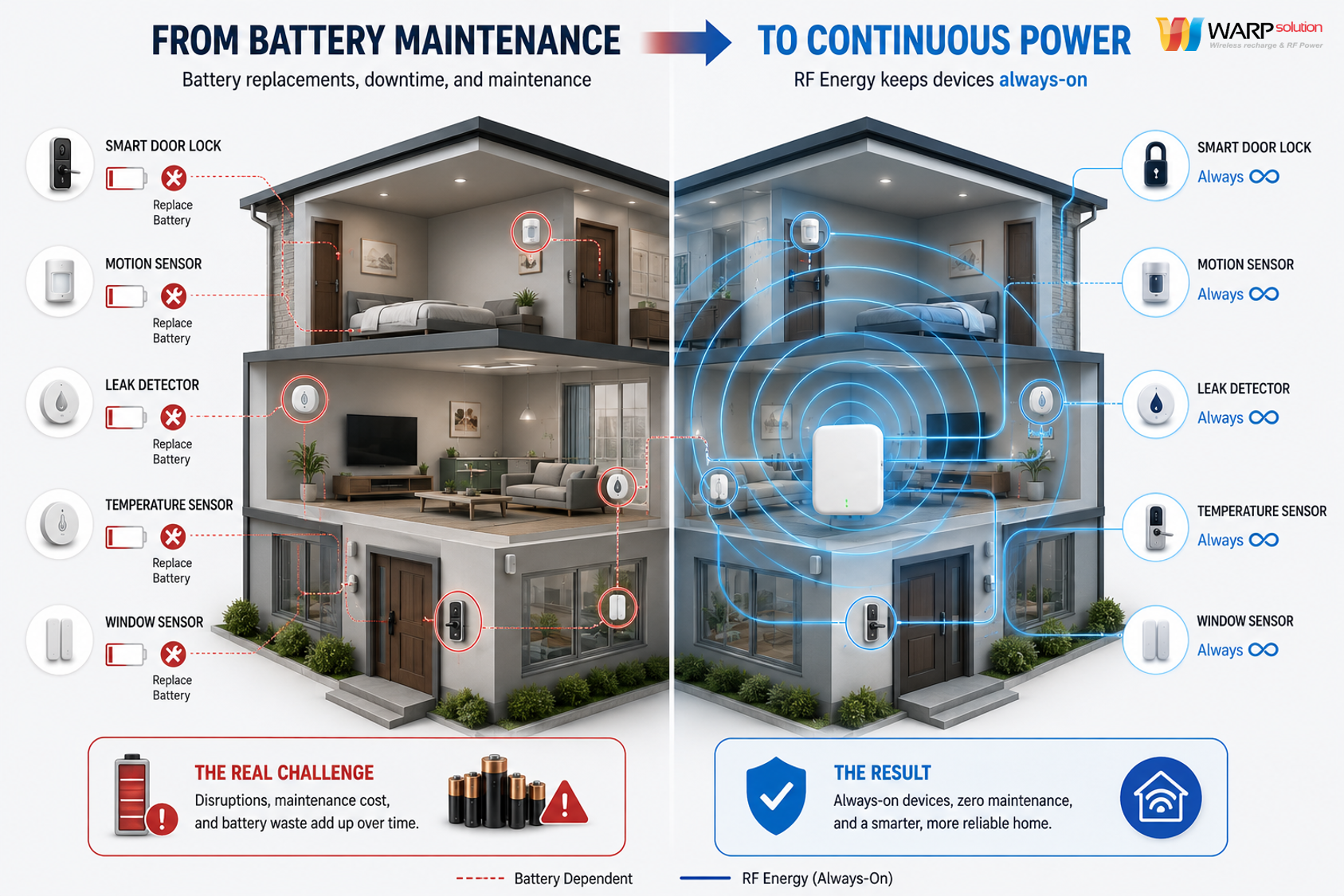
From Today's Smart Devices to Tomorrow's Wireless Power Ecosystem
Today, RF Energy is particularly valuable for low-power devices such as smart sensors, monitoring systems, and connected home infrastructure. These applications represent an immediate opportunity to reduce maintenance and simplify deployment.
At the same time, wireless power technology continues to evolve. Advances in RF semiconductors, antenna engineering, power management, and RF-to-DC conversion efficiency are expanding what is possible. Technologies that begin by supporting low-power devices often improve significantly over time as engineering capabilities advance.
The history of wireless communication provides a useful comparison. Early wireless systems offered capabilities that were far more limited than what people expect today. Continuous innovation transformed those technologies into essential parts of everyday life.
RF Energy is following a similar path. While today's applications focus on practical low-power devices, ongoing research and development continue to push the boundaries of wireless power performance.
The future smart home will not be defined by a single charging technology. Instead, it will likely combine multiple wireless power approaches working together to support different devices and power requirements. RF Energy is already beginning to play a role in that future, helping create homes that are not only smarter, but also easier to power, maintain, and scale.
Learn more about our innovative long-range RF wireless power solutions, We would like to help you.
Want to stay updated and see our latest innovations in action? Follow us on our social media channels! You can find us on LinkedIn and Instagram for insights, updates, and more.

Copyright ©2026 WARP Solution. All Rights Reserved