
The Green Promise of RF Energy: Building Sustainable Power Infrastructure Beyond Batteries
Author
Admin
Date
2026-06-12 13:00
Views
53
Sustainability is often discussed in terms of renewable energy, carbon reduction, and energy-efficient buildings. Yet one challenge receives far less attention: how to sustainably power the growing number of connected devices that support modern infrastructure.
From industrial sensors and electronic shelf labels to building automation systems and environmental monitoring networks, the number of low-power devices deployed worldwide continues to increase. While each device may consume only a small amount of power, collectively they create a significant operational challenge. Batteries must be manufactured, transported, installed, replaced, and eventually disposed of. As deployments scale from hundreds to thousands of devices, the environmental impact of maintaining these systems becomes increasingly difficult to ignore.
The future of sustainable infrastructure is not only about generating cleaner electricity. It is also about delivering power more efficiently, reducing maintenance requirements, and minimizing waste throughout the lifecycle of connected devices.

The Hidden Environmental Cost of Batteries
Batteries have enabled the rapid growth of IoT and wireless devices, but they also introduce a recurring cycle of maintenance and waste. Every battery-powered device eventually requires servicing, whether through battery replacement, recharging, or component replacement due to degradation over time.
The environmental impact extends far beyond the battery itself. Manufacturing processes consume raw materials and energy. Packaging and transportation add additional resource requirements. Maintenance visits often require personnel, vehicles, and operational downtime. Once batteries reach the end of their useful life, disposal and recycling introduce another layer of environmental responsibility.
For organizations managing large-scale deployments, these challenges multiply quickly. A facility operating thousands of sensors may face continuous maintenance activities throughout the year. Smart infrastructure projects, logistics centers, factories, and commercial buildings all face similar concerns as device density increases.
As sustainability becomes a strategic business objective, reducing battery dependency is emerging as an important opportunity to lower both operational costs and environmental impact.
RF Energy Is More Than Wireless Charging
When people hear the term wireless charging, they often think of consumer devices such as smartphones. However, RF Energy represents a much broader infrastructure technology designed to support low-power electronic devices without relying solely on conventional charging methods.
Unlike traditional power approaches, RF Energy operates as a complete ecosystem consisting of power generation, energy transmission, power reception, and device management. The performance of the entire system depends on how effectively these components work together.
At the transmission stage, RF power components generate and deliver RF energy to target devices. Technologies such as RF power amplifiers play a critical role in converting electrical power into RF signals capable of supporting wireless energy delivery across operational environments.
At the receiving stage, specialized semiconductors convert RF energy back into usable DC power. WARP Solution’s WEP Series is designed to perform efficient RF-to-DC conversion while maintaining compact form factors suitable for integration into a wide range of low-power devices. These receiver semiconductors serve as a critical link between transmitted RF energy and practical device operation.
Together, RF power generation technologies and RF receiver semiconductors form the foundation of an RF Energy ecosystem capable of supporting more sustainable power delivery strategies.
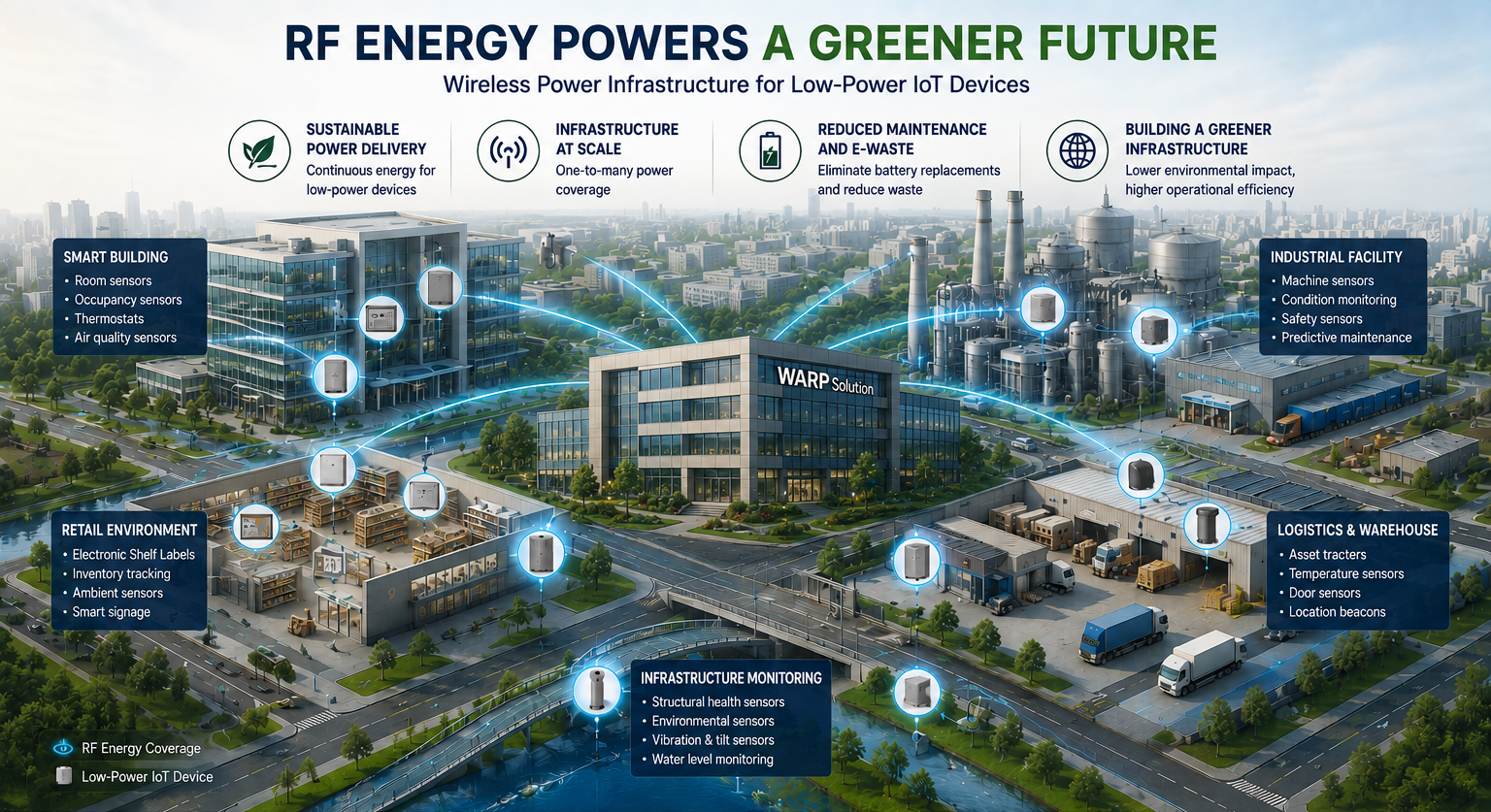
The Green Promise: Reducing Waste Across the Device Lifecycle
The sustainability value of RF Energy is not simply the removal of charging cables. Its greater potential lies in reducing waste throughout the entire lifecycle of connected devices.
By supplementing or reducing dependence on traditional battery replacement cycles, RF Energy can help extend operational lifetimes while lowering maintenance requirements. Fewer battery replacements mean fewer components entering the waste stream and fewer resources consumed through manufacturing, transportation, and disposal processes.
The benefits become increasingly meaningful in applications where devices are deployed in large quantities or difficult-to-access locations. Electronic shelf labels in retail environments, industrial monitoring sensors, asset tracking devices, and smart infrastructure systems all require reliable power over extended periods of time. Even small reductions in maintenance frequency can produce substantial environmental and operational benefits when applied across thousands of devices.
Beyond batteries, reducing maintenance interventions also contributes to sustainability. Fewer site visits, fewer replacement components, and lower servicing requirements collectively reduce the resources required to keep connected infrastructure operational.
This broader perspective highlights an important reality: sustainability is not only about energy consumption. It is also about reducing the material, labor, and operational resources required throughout a product’s lifecycle.
Building Sustainable Infrastructure for a Connected Future
As digital transformation accelerates, the number of connected devices integrated into buildings, factories, transportation systems, and public infrastructure will continue to grow. This expansion creates a new challenge for organizations seeking to balance technological advancement with environmental responsibility.
Traditional battery-dependent approaches may become increasingly difficult to manage as device density rises and maintenance demands expand. Organizations will need power strategies that support long-term reliability while reducing operational complexity and environmental impact.
RF Energy offers one potential pathway toward that future. Through efficient RF power generation, intelligent wireless energy delivery, advanced RF receiver semiconductors, and integrated power management, it enables a different approach to powering low-power devices. Rather than focusing solely on device-level performance, RF Energy encourages a system-level view of sustainability.
The green promise of RF Energy is not that it will eliminate every battery or replace every existing power technology. Its true value lies in helping organizations build infrastructure that requires fewer interventions, generates less waste, and operates more efficiently over time.
As industries continue to pursue smarter and more connected environments, sustainable power infrastructure will become an increasingly important consideration. In that future, technologies that reduce maintenance burdens and extend device lifecycles may play a critical role in supporting both operational efficiency and environmental goals.
Learn more about our innovative long-range RF wireless power solutions, We would like to help you.
Want to stay updated and see our latest innovations in action? Follow us on our social media channels! You can find us on LinkedIn and Instagram for insights, updates, and more.

Copyright ©2024 WARP Solution. All Rights Reserved