
Dynamic RF Charging in Public Transit: Enabling Uninterrupted Urban Mobility Beyond Transportation
Author
Admin
Date
2025-11-21 13:00
Views
222
Urban mobility is no longer defined simply by how buses, trams, or rail networks move people from one district to another. Modern cities are living organisms—dense, interconnected systems where not only passengers but also devices, micro-machines, digital services, and autonomous tools are constantly in motion. As our mobility systems evolve, one challenge has become universally evident: everything that moves needs power.
The push toward electrification has brought impressive progress, but maintaining a continuous energy flow across millions of interconnected devices remains a massive hurdle. Batteries help, but they impose inevitable boundaries. They create downtime, require maintenance, and shape the design limitations of modern mobility systems. This is where Dynamic RF charging—the wireless transfer of small but persistent amounts of power through radio frequency—rewrites what uninterrupted mobility can look like. And while many discussions focus on electric buses or RF-energized roads, this blog/article explores something broader: how dynamic RF charging unlocks new layers of urban mobility far beyond public transit vehicles. By reframing mobility as the constant circulation of people, data, goods, and services, we begin to see RF energy as the hidden infrastructure capable of powering the city’s future.
Pedestrian-Centric Mobility: Powering the Human Layer
When we imagine mobility, vehicles usually dominate the picture. Yet the most important mover in any city is the human being—and humans today rely on a growing ecosystem of digital tools. A commuter might carry a smartphone, smartwatch, wireless earbuds, a medical wearable, a navigation device, and a work badge, all of which drain power continuously. In mobility-intensive cities, battery anxiety is now a universal experience.
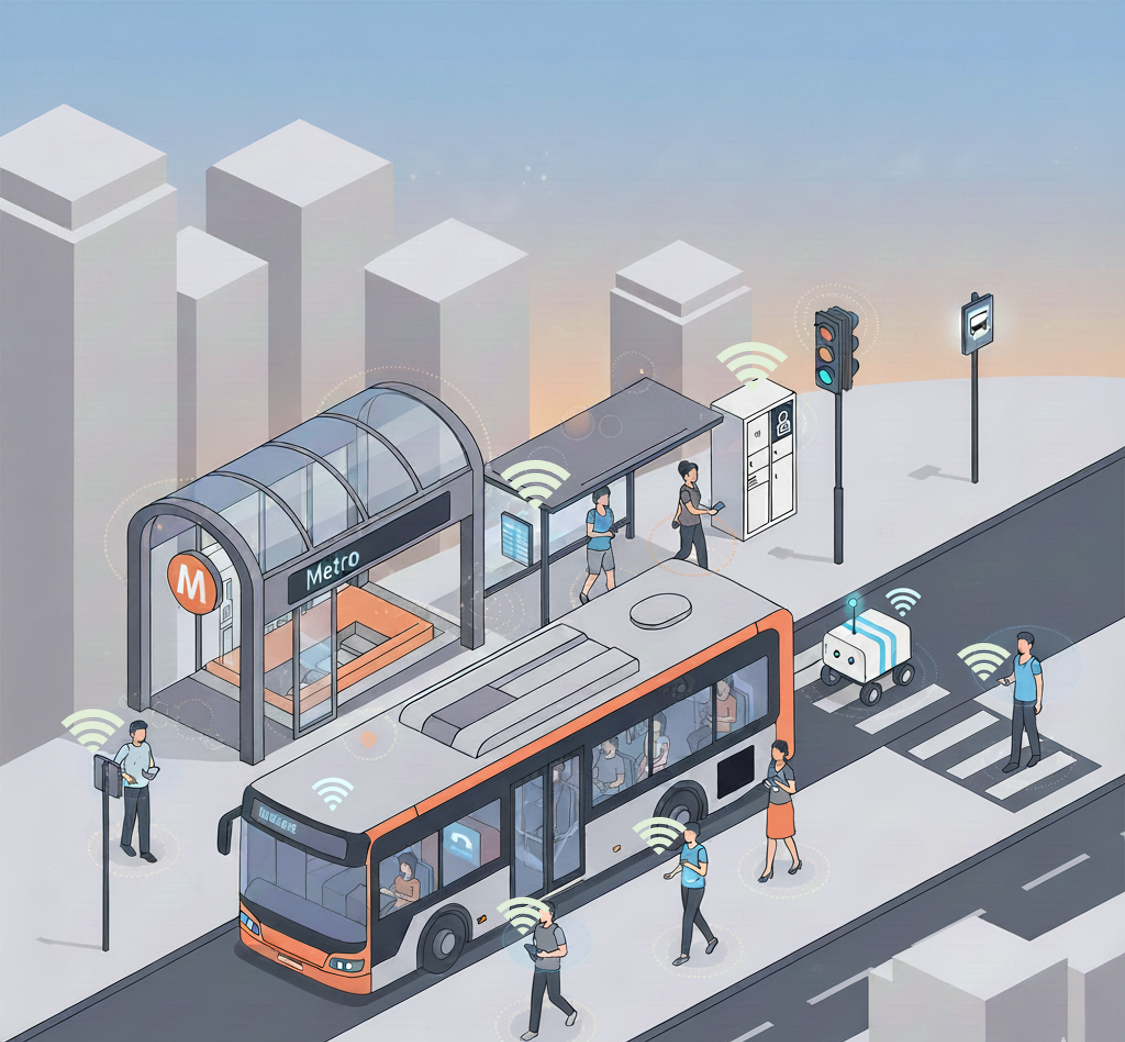
Dynamic RF charging offers an elegant solution by transforming transit hubs, sidewalks, and public spaces into low-power energy zones. Instead of hunting for power outlets or carrying extra chargers, people receive subtle trickle charging simply by moving through the city.
This is especially impactful for individuals using medical mobility devices: smart canes, portable oxygen concentrators, smart wheelchairs, or exoskeletons for assisted walking. These devices require reliability far beyond that of a consumer gadget. Even micro-level RF energy injections can extend operation time, reduce panic around low battery alerts, and provide people with continuous confidence in their mobility independence. RF energy, in this context, becomes a public service—an invisible safety net that supports everyday movement.
Robotic Urban Services: An Always-On Workforce
The second layer of modern mobility consists of thousands of small autonomous machines that quietly support city life. Cleaning robots in airports, security robots in transit stations, delivery bots in pedestrian zones, and inspection units in underground corridors all contribute to operational efficiency. But their workflows share one constraint: downtime for charging.
With dynamic RF charging, service robots can receive a constant low-level power supply while navigating city paths, reducing their dependence on docking stations and enabling longer missions. A cleaning robot in a busy metro station could maintain its energy buffer while doing its rounds. A delivery robot completing the last-mile logistics between a transit hub and a local store could self-sustain far longer than battery capacity alone allows. Even security patrol robots—often required to operate for hours without interruption—can extend their runtime through RF-rich corridors. This shift does not eliminate wired charging, but it dramatically reduces inefficiency by keeping essential machines above critical battery thresholds at all times.
Empowering Micro-Infrastructure: Small Devices, Big Mobility Impact
Behind every urban mobility experience lies an invisible web of micro-infrastructure: smart traffic lights, route signage, occupancy sensors, digital crosswalk signals, safety beacons, environmental monitors, and public information systems. These devices rarely attract attention, yet a single malfunction can cause significant disruptions.
Dynamic RF charging introduces a lightweight, maintenance-free way to energize these micro-systems. A smart bus stop sign can update schedules without ever needing a wired power connection. A roadside V2X module can stay active during grid fluctuations. Air-quality sensors around schools or stations can operate continuously without scheduled battery replacements. Even emergency call boxes or alarm beacons can remain functional in energy-constrained environments. In this sense, RF charging enhances not only convenience but also urban resilience, ensuring that the smallest elements of the mobility ecosystem remain online.
Logistics Mobility: Energizing Goods, Not Just People
Urban mobility includes more than transporting passengers—it also involves moving packages, materials, and micro-shipments across a city. With e-commerce and same-day delivery rapidly expanding, the “mobility of goods” has become as critical as the mobility of people.
RF charging can support this domain in several novel ways. Smart lockers and parcel kiosks stationed near transit hubs can operate with minimal wired infrastructure. Micro-hubs for last-mile logistics can use RF energy to support sensors, load balancers, and smart shelving. Even packages themselves can benefit: low-power sensors embedded in parcels can maintain connectivity through RF energy, enabling real-time tracking, temperature monitoring, and tamper alerts through the delivery journey. This creates a logistics flow that is smoother, more autonomous, and far more energy efficient.
Public Safety and Emergency Mobility: Power When Seconds Matter
Mobility is not only about convenience—it directly influences safety. First responders, security teams, and emergency workers carry a suite of devices: radios, body cameras, mobile routers, smart helmets, and medical tools. During large-scale events or emergencies, losing power is not an option.
Dynamic RF charging inside transit centers, public plazas, and vehicles ensures these devices receive opportunistic top-ups while teams move through high-traffic areas. Drones supporting incident response can gain small bursts of energy at RF-equipped rooftops or stations, enabling them to remain airborne for rapid intervention. Portable diagnostics or monitoring equipment, often used in ambulances or field operations, can maintain their charge while in public corridors. RF energy becomes a quiet enabler of high-stakes mobility operations.
Micromobility Reinvented: Beyond E-Bikes and Scooters
Urban micromobility often brings to mind e-scooters and e-bikes, but the category is expanding rapidly as cities embrace new forms of personal movement. From smart strollers and robotic shopping carts to intelligent walkers used by elderly citizens, micro-mobility devices shape how people navigate public spaces.
Dynamic RF charging makes these tools more dependable. A smart stroller guiding parents through busy streets can stay charged without cords. A mobility-assist walker can maintain essential connectivity for fall detection or health monitoring. Even recreational devices—smart skateboards, AR running wear, active helmets—become more usable when background charging becomes ambient. This opens micromobility to groups who were previously limited by battery dependency, such as seniors or individuals with disabilities.
Charging the Space, Not the Vehicle
A particularly transformative concept emerges when dynamic RF charging is integrated inside public transit vehicles and stations—not to charge the vehicle itself, but to energize everything inside it. Seats with sensors, occupancy counters, infotainment displays, validation devices, and communication modules can be sustained through ambient energy with minimal wiring.
For passengers, this means devices charging automatically during a bus or train ride, without finding a port or risking a crowded charging station. For transit operators, it reduces maintenance load and simplifies system design. The transit vehicle becomes an energy bubble where the environment itself is an active participant in powering mobility.
Toward the Ambient Power City
Dynamic RF charging does not replace all forms of power transfer. Instead, it acts as the cohesive layer that fills gaps, bridges constraints, and ensures continuity where wired solutions fall short. In a future city, the streets, stations, buildings, vehicles, and public spaces will form a seamless energy environment. People’s devices will never die unexpectedly. Robots will no longer pause their routines. Micro-infrastructure will be always-on and always-connected. Goods will move intelligently through the city without losing tracking capability.
This is uninterrupted mobility—not just for buses or trams, but for every part of the urban experience. Dynamic RF charging becomes the air that the smart city breathes: invisible, constant, and essential.
Learn more about our innovative long-range RF wireless power solutions, We would like to help you.
Want to stay updated and see our latest innovations in action? Follow us on our social media channels! You can find us on LinkedIn and Instagram for insights, updates, and more.

Copyright ©2024 WARP Solution. All Rights Reserved